Java String split方法用于根据给定的分隔符或正则表达式将String拆分为其子串。
例如:
String: [email protected]Regular Expression: @ Output : {"chaitanya", "singh"}Java 字符串拆分方法
我们在String类中有两种split()方法。
- String[] split(String regex):在根据分隔正则表达式拆分输入String后返回一个字符串数组。
String[] split(String regex, int limit):当我们想要限制子串时,使用这个String split方法。此方法与上述方法的唯一区别在于它限制了拆分后返回的字符串数。对于例如split("anydelimiter", 3)将返回仅 3 个字符串的数组,即使字符串中的分隔符超过 3 次也是如此。
如果限制为负,则返回的数组将具有尽可能多的子串,但是当限制为零时,返回的数组将具有除尾随空字符串之外的所有子串。
如果指定正则表达式的语法无效,则抛出PatternSyntaxException 。
Java String拆分示例
public class SplitExample{ public static void main(String args[]){ // This is out input String String str = new String("28/12/2013"); System.out.println("split(String regex):"); /* Here we are using first variation of java string split method * which splits the string into substring based on the regular * expression, there is no limit on the substrings */ String array1[]= str.split("/"); for (String temp: array1){ System.out.println(temp); } /* Using second variation of split method here. Since the limit is passed * as 2\. This method would only produce two substrings. */ System.out.println("split(String regex, int limit) with limit=2:"); String array2[]= str.split("/", 2); for (String temp: array2){ System.out.println(temp); } System.out.println("split(String regex, int limit) with limit=0:"); String array3[]= str.split("/", 0); for (String temp: array3){ System.out.println(temp); } /* When we pass limit as negative. The split method works same as the first variation * because negative limit says that the method returns substrings with no limit. */ System.out.println("split(String regex, int limit) with limit=-5:"); String array4[]= str.split("/", -5); for (String temp: array4){ System.out.println(temp); } }}输出:
split(String regex):28122013split(String regex, int limit) with limit=2:2812/2013split(String regex, int limit) with limit=0:28122013split(String regex, int limit) with limit=-5:28122013
java 字符串拆分方法中零和负限制之间的差异
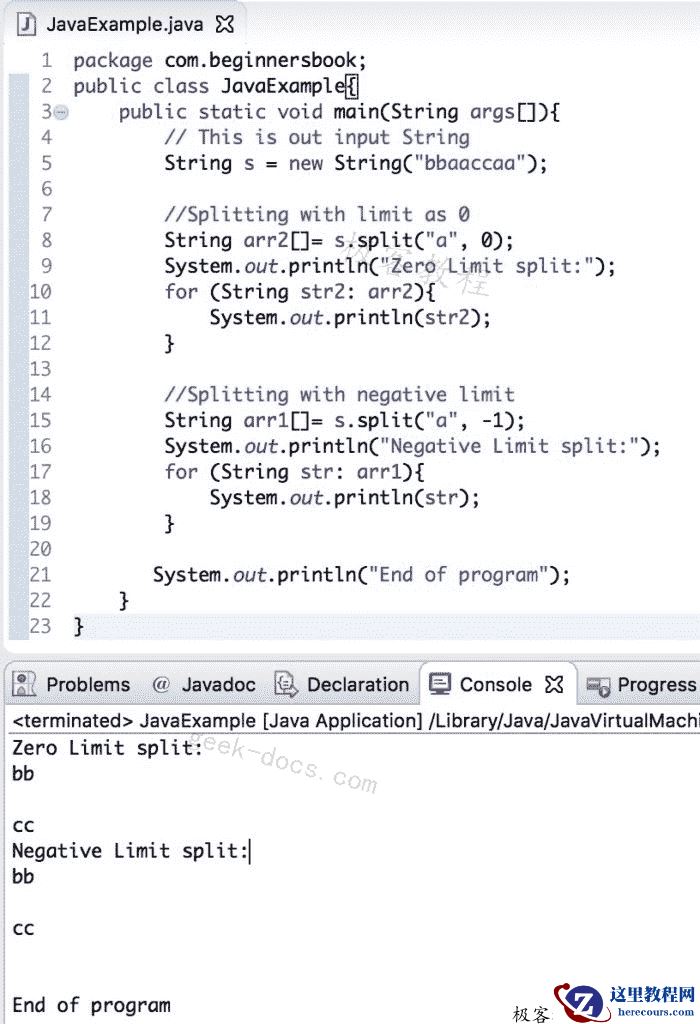
在上面的示例中,split("/", 0)和split("/", -5)返回相同的值,但在某些情况下,结果会有所不同。让我们通过一个例子来看看这两者之间的区别:
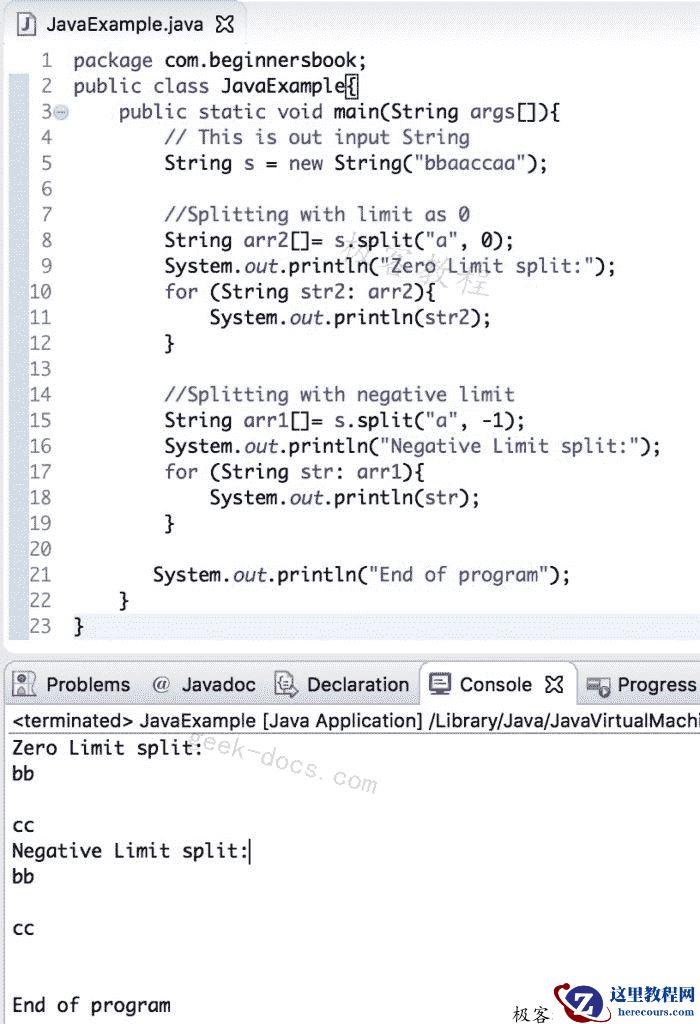
String s="bbaaccaa";String arr1[]= s.split("a", -1);String arr2[]= s.split("a", 0);在这种情况下,arr1将具有{"bb","","cc","",""}但是arr2将具有{"bb","","cc"},因为限制零不包括试验空字符串。
让我们看看完整的程序。
public class JavaExample{ public static void main(String args[]){ // This is out input String String s = new String("bbaaccaa"); //Splitting with limit as 0 String arr2[]= s.split("a", 0); System.out.println("Zero Limit split:"); for (String str2: arr2){ System.out.println(str2); } //Splitting with negative limit String arr1[]= s.split("a", -1); System.out.println("Negative Limit split:"); for (String str: arr1){ System.out.println(str); } System.out.println("End of program"); }}输出:
Java 带有多个分隔符(特殊字符)的字符串拆分
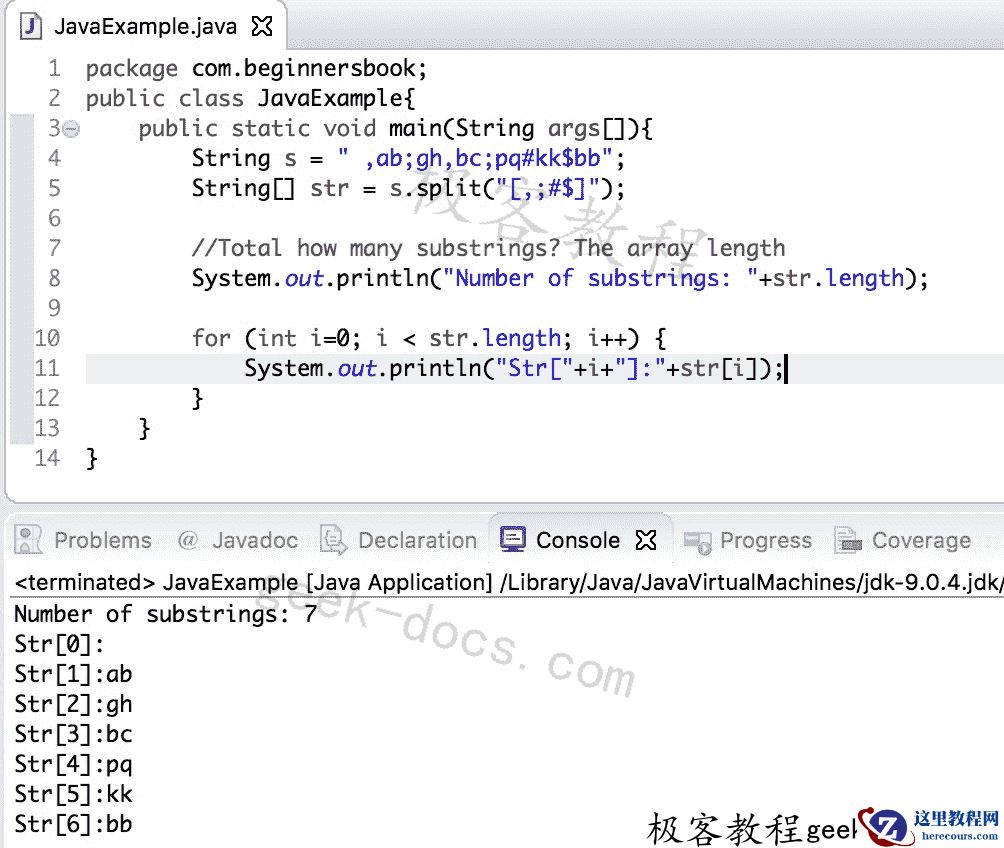
让我们看看我们如何在使用split()方法时传递多个分隔符。在这个例子中,我们基于多个特殊字符拆分输入字符串。
public class JavaExample{ public static void main(String args[]){ String s = " ,ab;gh,bc;pq#kkbb"; String[] str = s.split("[,;#]"); //Total how many substrings? The array length System.out.println("Number of substrings: "+str.length); for (int i=0; i < str.length; i++) { System.out.println("Str["+i+"]:"+str[i]); } }}输出:
让我们再练习几个例子:
示例:Java String split方法中的正则表达式
public class SplitExample1 { public static void main(String args[]) { String str = "helloxyzhixyzbye"; String[] arr = str.split("xyz"); for (String s : arr) System.out.println(s); } }输出:
hellohibye
示例:基于空格分割字符串
public class SplitExample2 { public static void main(String args[]) { String str = "My name is Chaitanya"; //regular expression is a whitespace here String[] arr = str.split(" "); for (String s : arr) System.out.println(s); } }输出:
MynameisChaitanya