golang结构体slice排序
go语言的slice()不仅仅可以对int类型的数组进行排序,还可以对struct类型的数组进行排序
排序函数
1. Slice() 不稳定排序2. SliceStable() 稳定排序3. SliceIsSorted() 判断是否已排序结构体定义如下,我们完全可以定义更复杂的结构体:
// 结构体定义
type test struct {
	value int
	str   string
}
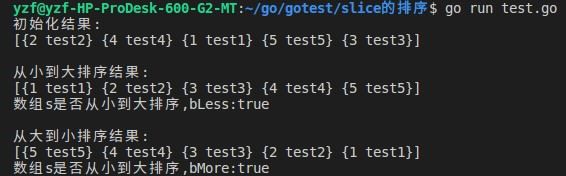
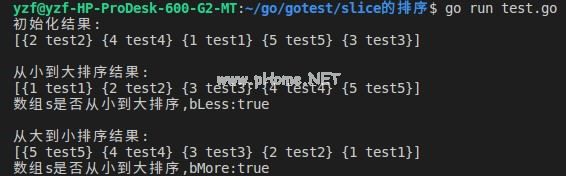
结果
完整代码
package main

import (
	"fmt"
	"sort"
)

// 结构体定义
type test struct {
	value int
	str   string
}

func main() {
	s := make([]test, 5)
	s[0] = test{value: 2, str: "test2"}
	s[1] = test{value: 4, str: "test4"}
	s[2] = test{value: 1, str: "test1"}
	s[3] = test{value: 5, str: "test5"}
	s[4] = test{value: 3, str: "test3"}
	fmt.Println("初始化结果:")
	fmt.Println(s)

	// 从小到大排序(不稳定排序)
	sort.Slice(s, func(i, j int) bool {
		if s[i].value < s[j].value {
			return true
		}
		return false
	})
	fmt.Println("\n从小到大排序结果:")
	fmt.Println(s)

	// 从小到大排序(稳定排序)
	sort.SliceStable(s, func(i, j int) bool {
		if s[i].value < s[j].value {
			return true
		}
		return false
	})

	// 是否从小到大排序
	bLess := sort.SliceIsSorted(s, func(i, j int) bool {
		if s[i].value < s[j].value {
			return true
		}
		return false
	})
	fmt.Printf("数组s是否从小到大排序,bLess:%v\n", bLess)

	// 从大到小排序(不稳定排序)
	sort.Slice(s, func(i, j int) bool {
		if s[i].value > s[j].value {
			return true
		}
		return false
	})
	fmt.Println("\n从大到小排序结果:")
	fmt.Println(s)

	// 是否从大到小排序
	bMore := sort.SliceIsSorted(s, func(i, j int) bool {
		if s[i].value > s[j].value {
			return true
		}
		return false
	})
	fmt.Printf("数组s是否从大到小排序,bMore:%v\n", bMore)
}
总结
以上为个人经验,希望能给大家一个参考,也希望大家多多支持。