在本指南中,我们将学习如何在 C 程序中使用指针和数组。我建议你在阅读本指南之前参考数组和指针教程,这样你就可以很容易地理解这里解释的概念了。
打印数组元素地址的简单示例
#include <stdio.h>int main( ){ int val[7] = { 11, 22, 33, 44, 55, 66, 77 } ; /* for loop to print value and address of each element of array*/ for ( int i = 0 ; i < 7 ; i++ ) { /* The correct way of displaying the address would be using %p format * specifier like this: * printf("val[%d]: value is %d and address is %p\n", i, val[i], &val[i]); * Just to demonstrate that the array elements are stored in contiguous * locations, I m displaying the addresses in integer */ printf("val[%d]: value is %d and address is %d\n", i, val[i], &val[i]); } return 0;}输出:
val[0]: value is 11 and address is 1423453232val[1]: value is 22 and address is 1423453236val[2]: value is 33 and address is 1423453240val[3]: value is 44 and address is 1423453244val[4]: value is 55 and address is 1423453248val[5]: value is 66 and address is 1423453252val[6]: value is 77 and address is 1423453256
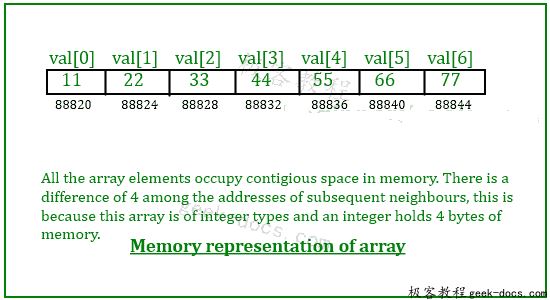
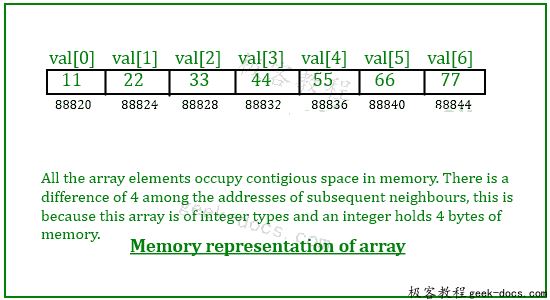
请注意,每个元素之间存在 4 个字节的差异,因为这是整数的大小。这意味着所有元素都存储在内存中的连续位置。(参见下图)
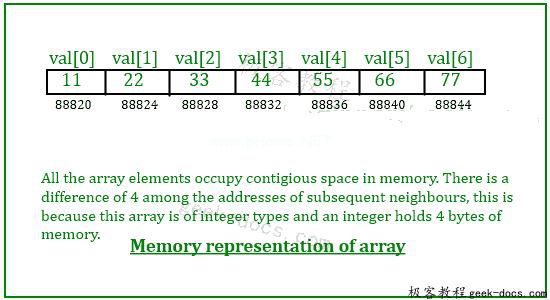
在上面的例子中,我使用&val[i]来获取数组的第i个元素的地址。我们也可以使用指针变量而不是使用&符号来获取地址。
示例 – C 中的数组和指针示例
#include <stdio.h>int main( ){ /*Pointer variable*/ int *p; /*Array declaration*/ int val[7] = { 11, 22, 33, 44, 55, 66, 77 } ; /* Assigning the address of val[0] the pointer * You can also write like this: * p = var; * because array name represents the address of the first element */ p = &val[0]; for ( int i = 0 ; i<7 ; i++ ) { printf("val[%d]: value is %d and address is %p\n", i, *p, p); /* Incrementing the pointer so that it points to next element * on every increment. */ p++; } return 0;}输出:
val[0]: value is 11 and address is 0x7fff51472c30val[1]: value is 22 and address is 0x7fff51472c34val[2]: value is 33 and address is 0x7fff51472c38val[3]: value is 44 and address is 0x7fff51472c3cval[4]: value is 55 and address is 0x7fff51472c40val[5]: value is 66 and address is 0x7fff51472c44val[6]: value is 77 and address is 0x7fff51472c48
注意事项:
1)使用数组和指针时,指针的数据类型必须与数组的数据类型匹配。
2)你也可以使用数组名来初始化指针,如下所示:
p = var;
因为数组名称本身就等于数组的基址。
val==&val[0];
3)在循环中,对指针变量执行递增操作(p++)以获取下一个位置(下一个元素的位置),此算法对于所有类型的数组都是相同的(对于所有数据类型double,char,int等)即使每种数据类型消耗的字节不同。
指针逻辑
你必须已经理解了上面代码中的逻辑,所以现在是时候玩几个指针算术和表达式了。
if p = &val[0] which means*p ==val[0](p+1) == &val[2] & *(p+1) == val[2](p+2) == &val[3] & *(p+2) == val[3](p+n) == &val[n+1) & *(p+n) == val[n+1]
使用这个逻辑,我们可以用更好的方式重写我们的代码:
#include <stdio.h>int main( ){ int *p; int val[7] = { 11, 22, 33, 44, 55, 66, 77 } ; p = val; for ( int i = 0 ; i<7 ; i++ ) { printf("val[%d]: value is %d and address is %p\n", i, *(p+i), (p+i)); } return 0;}我们在这个程序中不需要p++语句。